Black Families and the Struggle for Survival Reference
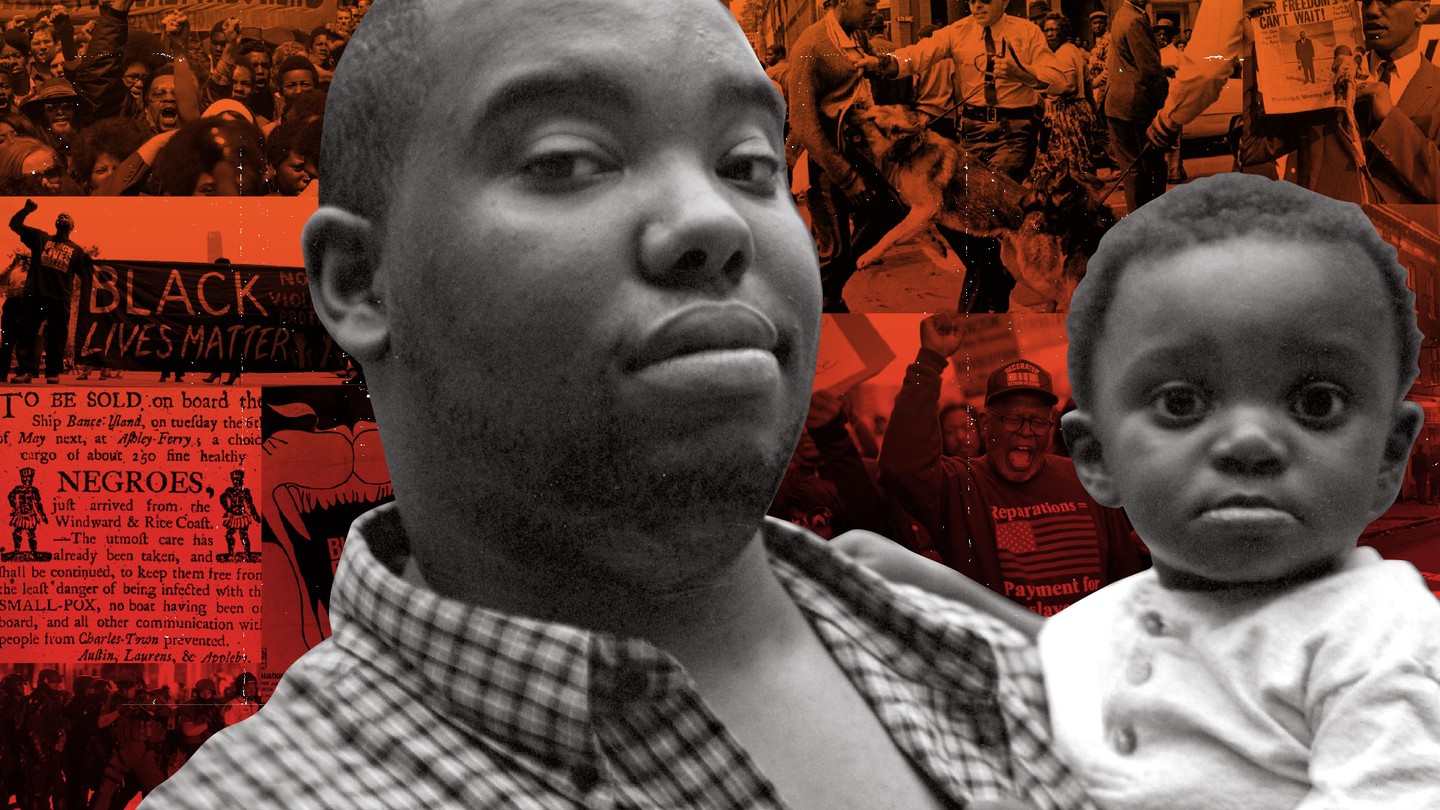
Alphabetic character to My Son
"Here is what I would like for you to know: In America, it is traditional to destroy the black trunk—it is heritage."
And have brought humanity to the border of oblivion: because they think they are white.
—James Baldwin
Son,
Last Sunday the host of a pop news show asked me what it meant to lose my trunk. The host was broadcasting from Washington, D.C., and I was seated in a remote studio on the Far West Side of Manhattan. A satellite closed the miles betwixt united states, but no mechanism could close the gap between her world and the world for which I had been summoned to speak. When the host asked me about my torso, her face faded from the screen, and was replaced by a scroll of words, written by me earlier that week.
The host read these words for the audience, and when she finished she turned to the subject area of my body, although she did not mention it specifically. Merely past now I am accustomed to intelligent people asking most the status of my body without realizing the nature of their request. Specifically, the host wished to know why I felt that white America's progress, or rather the progress of those Americans who believe that they are white, was built on looting and violence. Hearing this, I felt an old and indistinct sadness well upwardly in me. The reply to this question is the record of the believers themselves. The reply is American history.
There is nix extreme in this statement. Americans deify commonwealth in a mode that allows for a dim awareness that they have, from time to fourth dimension, stood in defiance of their God. This defiance is not to be much dwelled upon. Democracy is a forgiving God and America's heresies—torture, theft, enslavement—are specimens of sin, then common amidst individuals and nations that none can declare themselves allowed. In fact, Americans, in a real sense, have never betrayed their God. When Abraham Lincoln alleged, in 1863, that the battle of Gettysburg must ensure "that authorities of the people, past the people, for the people, shall not perish from the world," he was not merely beingness aspirational. At the onset of the Civil War, the U.s. of America had one of the highest rates of suffrage in the world. The question is not whether Lincoln truly meant "government of the people" simply what our country has, throughout its history, taken the political term people to actually mean. In 1863 information technology did not mean your mother or your grandmother, and information technology did not mean yous and me. As for now, it must be said that the height of the belief in being white was not achieved through wine tastings and ice-cream socials, just rather through the pillaging of life, liberty, labor, and state.
That Sunday, on that news show, I tried to explain this as best I could within the time allotted. But at the end of the segment, the host flashed a widely shared picture of a 12-yr-old black boy tearfully hugging a white police officer. Then she asked me about "hope." And I knew then that I had failed. And I remembered that I had expected to neglect. And I wondered once more at the indistinct sadness welling up in me. Why exactly was I sad? I came out of the studio and walked for a while. It was a calm late-November twenty-four hours. Families, believing themselves white, were out on the streets. Infants, raised to be white, were bundled in strollers. And I was sorry for these people, much as I was sad for the host and distressing for all the people out at that place watching and reveling in a specious hope. I realized then why I was sad. When the journalist asked me about my body, information technology was like she was asking me to awaken her from the nigh gorgeous dream. I have seen that dream all my life. It is perfect houses with nice lawns. It is Memorial Twenty-four hours cookouts, block associations, and driveways. The Dream is tree houses and the Cub Scouts. And for then long I have wanted to escape into the Dream, to fold my country over my head like a blanket. Merely this has never been an option, because the Dream rests on our backs, the bedding made from our bodies. And knowing this, knowing that the Dream persists past warring with the known world, I was sad for the host, I was sad for all those families, I was lamentable for my country, but above all, in that moment, I was sad for you lot.
That was the week yous learned that the killers of Michael Brownish would go complimentary. The men who had left his body in the street would never be punished. It was non my expectation that anyone would always be punished. But you were young and withal believed. You stayed upwards till eleven p.g. that dark, waiting for the announcement of an indictment, and when instead information technology was announced that there was none you said, "I've got to go," and you went into your room, and I heard yous crying. I came in v minutes afterwards, and I didn't hug yous, and I didn't condolement you, because I thought it would be wrong to comfort you. I did non tell you that it would exist okay, considering I have never believed it would be okay. What I told you lot is what your grandparents tried to tell me: that this is your country, that this is your globe, that this is your body, and you must find some fashion to live inside the all of it.
I write you in your 15th yr. I am writing you because this was the yr you saw Eric Garner choked to death for selling cigarettes; because you know now that Renisha McBride was shot for seeking help, that John Crawford was shot down for browsing in a department store. And you have seen men in uniform drive by and murder Tamir Rice, a 12-year-old child whom they were adjuration-bound to protect. And you know now, if you did not before, that the police departments of your country take been endowed with the authority to destroy your body. It does not affair if the devastation is the consequence of an unfortunate overreaction. It does not matter if it originates in a misunderstanding. Information technology does not thing if the destruction springs from a foolish policy. Sell cigarettes without the proper authorization and your body tin can be destroyed. Turn into a dark stairwell and your trunk can be destroyed. The destroyers will rarely exist held accountable. Mostly they volition receive pensions.
There is nothing uniquely evil in these destroyers or fifty-fifty in this moment. The destroyers are just men enforcing the whims of our land, correctly interpreting its heritage and legacy. This legacy aspires to the shackling of blackness bodies. It is hard to confront this. But all our phrasing—race relations, racial chasm, racial justice, racial profiling, white privilege, even white supremacy—serves to obscure that racism is a visceral experience, that it dislodges brains, blocks airways, rips muscle, extracts organs, cracks bones, breaks teeth. You lot must never look away from this. You must ever retrieve that the folklore, the history, the economic science, the graphs, the charts, the regressions all land, with corking violence, upon the body. And should one live in such a body? What should exist our aim beyond meager survival of abiding, generational, ongoing battery and assault? I accept asked this question all my life. I accept sought the respond through my reading and writings, through the music of my youth, through arguments with your grandpa, with your female parent. I have searched for answers in nationalist myth, in classrooms, out on the streets, and on other continents. The question is unanswerable, which is not to say futile. The greatest reward of this constant interrogation, of confrontation with the brutality of my state, is that it has freed me from ghosts and myths.
And yet I am notwithstanding afraid. I experience the fearfulness about acutely whenever you leave me. But I was afraid long before you, and in this I was unoriginal. When I was your age the only people I knew were black, and all of them were powerfully, adamantly, dangerously afraid. It was always right in front of me. The fearfulness was in that location in the extravagant boys of my West Baltimore neighborhood, in their big rings and medallions, their big puffy coats and total-length fur-collared leathers, which was their armor against their globe. They would stand on the corner of Gwynn Oak and Freedom, or Cold Spring and Park Heights, or outside Mondawmin Mall, with their easily dipped in Russell sweats. I recall back on those boys now and all I see is fright, and all I see is them girding themselves confronting the ghosts of the bad erstwhile days when the Mississippi mob gathered 'round their grandfathers so that the branches of the black body might be torched, so cut away. The fear lived on in their practiced bop, their slouching denim, their big T- shirts, the calculated bending of their baseball game caps, a catalog of behaviors and garments enlisted to inspire the belief that these boys were in firm possession of everything they desired.
I felt the fright in the visits to my Nana's home in Philadelphia. You never knew her. I barely knew her, but what I retrieve is her difficult mode, her rough voice. And I knew that my begetter's father was dead and that my Uncle Oscar was dead and that my Uncle David was dead and that each of these instances was unnatural. And I saw it in my ain father, who loves you, who counsels y'all, who slipped me money to care for you. My father was so very afraid. I felt it in the sting of his black leather belt, which he applied with more anxiety than anger, my father who beat me as if someone might steal me away, considering that is exactly what was happening all around usa. Anybody had lost a child, somehow, to the streets, to jail, to drugs, to guns. It was said that these lost girls were sweet as love and would not hurt a fly. It was said that these lost boys had only received a GED and had begun to turn their lives around. And now they were gone, and their legacy was a great fear.
When I was half dozen, Ma and Dad took me to a local park. I slipped from their gaze and constitute a playground. Your grandparents spent anxious minutes looking for me. When they found me, Dad did what every parent I knew would take done—he reached for his belt. I remember watching him in a kind of daze, awed at the altitude between punishment and law-breaking. Later, I would hear it in Dad'south vocalisation—"Either I can beat him, or the law." Maybe that saved me. Maybe it didn't. All I know is, the violence rose from the fright like smoke from a burn, and I cannot say whether that violence, even administered in fear and love, sounded the alarm or choked us at the exit. What I know is that fathers who slammed their teenage boys for sass would so release them to streets where their boys employed, and were subject to, the aforementioned justice. And I knew mothers who belted their girls, but the belt could not save these girls from drug dealers twice their historic period.
To be black in the Baltimore of my youth was to exist naked earlier the elements of the world, before all the guns, fists, knives, cleft, rape, and affliction. The law did not protect usa. And now, in your time, the law has become an alibi for stopping and frisking you, which is to say, for furthering the assault on your body. Only a society that protects some people through a safety cyberspace of schools, authorities-backed home loans, and bequeathed wealth merely tin protect y'all only with the gild of criminal justice has either failed at enforcing its good intentions or succeeded at something much darker.
I retrieve being eleven years one-time, continuing out in the parking lot in forepart of the 7-Eleven, watching a crew of older boys standing about the street. I stood there, marveling at the older boys' beautiful sense of fashion. They all wore ski jackets, the kind that mothers put on layaway in September, then piled up overtime hours and then as to have the thing wrapped and ready for Christmas. A light-skinned boy with a long head and small optics was scowling at another boy, who was standing shut to me. It was simply before 3 in the afternoon. I was in sixth grade. School had just let out, and information technology was not yet the fighting weather of early leap. What was the verbal problem here? Who could know?
The boy with the small eyes reached into his ski jacket and pulled out a gun. I recall it in the slowest motion, as though in a dream. There the male child stood, with the gun brandished, which he slowly untucked, tucked, and so untucked once again, and in his pocket-sized eyes I saw a surging rage that could, in an instant, erase my body. That was 1986. That year I felt myself to exist drowning in the news reports of murder. I was aware that these murders very oft did not land upon the intended targets simply fell upon nifty-aunts, PTA mothers, overtime uncles, and blithesome children—fell upon them random and relentless, like great sheets of pelting. I knew this in theory simply could not empathise it equally fact until the boy with the small eyes stood beyond from me holding my entire body in his small hands.
I recall being amazed that death could then hands rise upward from the cipher of a adolescent afternoon, breaker up like fog. I knew that West Baltimore, where I lived; that the north side of Philadelphia, where my cousins lived; that the South Side of Chicago, where friends of my father lived, comprised a globe apart. Somewhere out at that place across the empyrean, past the asteroid belt, in that location were other worlds where children did non regularly fear for their bodies. I knew this because in that location was a large television in my living room. In the evenings I would sit before this television begetting witness to the dispatches from this other world. In that location were piffling white boys with complete collections of football cards; their but want was a popular girlfriend and their only worry was poisonous substance oak. That other globe was suburban and countless, organized around pot roasts, blueberry pies, fireworks, ice-foam sundaes, immaculate bathrooms, and small-scale toy trucks that were loosed in wooded backyards with streams and endless lawns. Comparing these dispatches with the facts of my native world, I came to understand that my country was a milky way, and this galaxy stretched from the pandemonium of West Baltimore to the happy hunting grounds of Mr. Belvedere. I obsessed over the distance betwixt that other sector of space and my own. I knew that my portion of the American galaxy, where bodies were enslaved by a tenacious gravity, was black and that the other, liberated portion was not. I knew that some inscrutable energy preserved the breach. I felt, but did not however understand, the relation betwixt that other world and me. And I felt in this a cosmic injustice, a profound cruelty, which infused an abiding, irrepressible want to unshackle my trunk and achieve the velocity of escape.
Before I could escape, I had to survive, and this could simply mean a clash with the streets, by which I mean not merely physical blocks, nor simply the people packed into them, but the array of lethal puzzles and strange perils that seem to rise up from the cobblestone itself. The streets transform every ordinary solar day into a series of play a joke on questions, and every wrong answer risks a vanquish-down, a shooting, or a pregnancy. No ane survives unscathed. When I was your age, fully one-3rd of my brain was concerned with whom I was walking to school with, our precise number, the manner of our walk, the number of times I smiled, whom or what I smiled at, who offered a pound and who did not—all of which is to say that I practiced the culture of the streets, a culture concerned chiefly with securing the torso.
The culture of the streets was essential—there was no alternative. I could not retreat into the church and its mysteries. My parents rejected all dogmas. We spurned the holidays marketed by the people who wanted to be white. We would non stand for their anthems. We would not kneel before their God. "The meek shall inherit the world" meant nothing to me. The meek were dilapidated in West Baltimore, stomped out at Walbrook Junction, bashed up on Park Heights, and raped in the showers of the city jail. My agreement of the universe was physical, and its moral arc bent toward anarchy and then concluded in a box. That was the bulletin of the small-eyed male child, untucking the piece—a child bearing the power to trunk and blackball other children to memory. Fearfulness ruled everything effectually me, and I knew, as all black people practise, that this fearfulness was connected to the world out in that location, to the unworried boys, to pie and pot roast, to the white fences and green lawns nightly beamed into our tv sets.
Every February my classmates and I were herded into assemblies for a ritual review of the ceremonious-rights movement. Our teachers urged united states toward the example of freedom marchers, Freedom Riders, and Freedom Summers, and it seemed that the calendar month could not pass without a series of films defended to the glories of being browbeaten on camera. Why are they showing this to usa? Why were only our heroes nonviolent? Dorsum then all I could practise was measure out these freedom-lovers by what I knew. Which is to say, I measured them against children pulling out in the 7-Eleven parking lot, against parents wielding extension cords, and the threatening intonations of armed black gangs saying, "Yep, nigger, what's upward now?" I judged them against the country I knew, which had caused the land through murder and tamed it under slavery, against the land whose armies fanned out beyond the world to extend their rule. The globe, the real one, was civilization secured and ruled by savage means. How could the schools valorize men and women whose values society actively scorned? How could they send us out into the streets of Baltimore, knowing all that they were, and so speak of nonviolence?
Some things were clear to me: The violence that undergirded the country, so flagrantly on display during Black History Calendar month, and the intimate violence of the streets were not unrelated. And this violence was non magical, simply was of a piece and past blueprint. But what exactly was the pattern? And why? I must know. I must get out ... but into what? I saw the design in those in the boys on the corner, in "the babies having babies." The design explained everything, from our cracked-out fathers to HIV to the bleached skin of Michael Jackson. I felt this only I could not explicate it. This was two years earlier the 1000000 Man March. Almost every day I played Ice Cube's album Decease Document: "Let me alive my life, if we can no longer live our life, then permit usa give our life for the liberation and conservancy of the black nation." I was haunted by the actual cede of Malcolm. I was haunted because I believed that nosotros had left ourselves back there, and at present in the scissure era all we had was a great fear. Perhaps I must go dorsum. That was what I heard in the rapper's call to "proceed it existent." Perhaps nosotros should return to ourselves, to our own primordial streets, to our own ruggedness, to our own rude pilus. Perhaps we should return to Mecca.
My only Mecca was, is, and shall always exist Howard Academy. This Mecca, My Mecca—The Mecca—is a machine, crafted to capture and concentrate the night energy of all African peoples and inject it directly into the student body. The Mecca derives its power from the heritage of Howard University, which in Jim Crow days enjoyed a virtually-monopoly on black talent. And whereas most other historically black schools were scattered like forts in the great wilderness of the former Confederacy, Howard was in Washington, D.C.—Chocolate City—and thus in proximity to both federal ability and black ability. I first witnessed this power out on the Yard, that communal green space in the center of the campus where the students gathered and I saw everything I knew of my blackness cocky multiplied out into seemingly endless variations. There were the scions of Nigerian aristocrats in their business suits giving dap to bald-headed Qs in purple windbreakers and tan Timbs. There were the high-yellow progeny of A.M.East. preachers debating the clerics of Ausar-Fix. There were California girls turned Muslim, born anew, in hijab and long skirt. There were Ponzi schemers and Christian cultists, Tabernacle fanatics and mathematical geniuses. Information technology was like listening to a hundred different renditions of "Redemption Song," each in a different color and fundamental. And overlaying all of this was the history of Howard itself. I knew that I was literally walking in the footsteps of all the Toni Morrisons and Zora Neale Hurstons, of all the Sterling Browns and Kenneth Clarks, who'd come up before.
The Mecca—the vastness of black people beyond space-time—could exist experienced in a twenty-minute walk across campus. I saw this vastness in the students chopping it upward in front of the Frederick Douglass Memorial Hall, where Muhammad Ali had addressed their fathers and mothers in disobedience of the Vietnam State of war. I saw its epic sweep in the students adjacent to Ira Aldridge Theater, where Donny Hathaway had in one case sung, where Donald Byrd had once assembled his flock. The students came out with their saxophones, trumpets, and drums, played "My Favorite Things" or "Someday My Prince Volition Come up." Some of the other students were out on the grass in front of Alain Locke Hall, in pink and dark-green, chanting, singing, stomping, clapping, stepping. Some of them came up from Tubman Quadrangle with their roommates and rope for double Dutch. Some of them came down from Drew Hall, with their caps cocked and their backpacks slung through 1 arm, so fell into gorgeous ciphers of beatbox and rhyme. Some of the girls saturday by the flagpole with bong hooks and Sonia Sanchez in their straw totes. Some of the boys, with their new Yoruba names, beseeched these girls by citing Frantz Fanon. Some of them studied Russian. Some of them worked in bone labs. They were Panamanian. They were Bajan. And some of them were from places I had never heard of. But all of them were hot and incredible, exotic fifty-fifty, though we hailed from the same tribe.
Now, the heirs of slaveholders could never directly acknowledge our beauty or reckon with its power. And so the beauty of the black trunk was never historic in movies, on television shows, or in the textbooks I'd seen as a child. Anybody of whatever import, from Jesus to George Washington, was white. This was why your grandparents banned Tarzan and the Lonely Ranger and toys with white faces from the firm. They were rebelling against the history books that spoke of black people only as sentimental "firsts"—first black iv-star general, commencement black congressman, first blackness mayor—e'er presented in the bemused manner of a category of Trivial Pursuit. Serious history was the West, and the West was white. This was all distilled for me in a quote I once read, from the novelist Saul Bellow. I tin can't remember where I read information technology, or when—only that I was already at Howard. "Who is the Tolstoy of the Zulus?," Bellow quipped. Tolstoy was "white," I understood him to say, and then Tolstoy "mattered," like everything else that was white "mattered." And this view of things was connected to the fearfulness that passed through the generations, to the sense of dispossession. We were black, across the visible spectrum, beyond civilization. Our history was inferior because we were inferior, which is to say our bodies were inferior. And our inferior bodies could not possibly be accorded the same respect as those that built the West. Would it non be better, then, if our bodies were civilized, improved, and put to some legitimate Christian use?
And then I came to Howard toting a new and different history, myth actually, which inverted all the stories of the people who believed themselves to exist white. I majored in history with all the motives of a homo looking to make full a trophy case. They had heroes, then we must have heroes too. Only my history professors idea nothing of telling me that my search for myth was doomed, that the stories I wanted to tell myself could non exist matched to truths. Indeed, they felt information technology their duty to disabuse me of my weaponized history. Their method was rough and directly. Did black skin actually convey nobility? Ever? Yes. What about the blacks who'd practiced slavery for millennia and sold slaves across the Sahara and and then beyond the sea? Victims of a pull a fast one on. Would those exist the same blackness kings who birthed all of civilization? Were they then both deposed masters of the galaxy and gullible puppets all at once? And what did I mean past "black"? You know, blackness. Did I think this a timeless category stretching into the deep past? Yes? Could it be supposed that simply because color was important to me, information technology had always been so?
This heap of realizations was a weight. I found them physically painful and exhausting. True, I was coming to savour the dizziness, the vertigo that must come up with any odyssey. But in those early moments, the unceasing contradictions sent me into a gloom. There was zero holy or particular in my skin; I was black because of history and heritage. In that location was no nobility in falling, in being bound, in living oppressed, and there was no inherent pregnant in black blood. Black blood wasn't black; black pare wasn't even blackness. And now I looked back on my need for a trophy example, on the desire to live by the standards of Saul Bellow, and I felt that this need was not an escape but fear again—fearfulness that "they," the declared authors and heirs of the universe, were correct. And this fear ran so deep that we accepted their standards of civilization and humanity.
But not all of us. It must take been around that time that I discovered an essay by Ralph Wiley in which he responded to Bellow's quip. "Tolstoy is the Tolstoy of the Zulus," wrote Wiley. "Unless you observe a profit in fencing off universal properties of flesh into exclusive tribal buying." And there it was. I had accepted Bellow's premise. In fact, Bellow was no closer to Tolstoy than I was to Nzinga. And if I were closer it would be considering I chose to be, non because of destiny written in Dna. My slap-up error was non that I had accepted someone else's dream just that I had accepted the fact of dreams, the need for escape, and the invention of racecraft.
And still and all I knew that we were something, that we were a tribe—on one hand, invented, and on the other, no less existent. The reality was out at that place on the Yard, on the first warm day of leap when it seemed that every sector, borough, amalgamation, canton, and corner of the broad diaspora had sent a delegate to the nifty world party. I recall those days like an OutKast vocal, painted in animalism and joy. The black world was expanding before me, and I could see now that that globe was more than than a photonegative of that of the people who believe they are white. "White America" is a syndicate arrayed to protect its exclusive ability to dominate and command our bodies. Sometimes this power is direct (lynching), and sometimes information technology is insidious (redlining). But however it appears, the power of domination and exclusion is fundamental to the belief in being white, and without information technology, "white people" would cease to exist for want of reasons. There volition surely always be people with straight pilus and bluish eyes, as there have been for all of history. But some of these directly-haired people with bluish eyes have been "black," and this points to the great difference between their world and ours. Nosotros did not choose our fences. They were imposed on us by Virginia planters obsessed with enslaving as many Americans as possible. Now I saw that we had made something down here, in slavery, in Jim Crow, in ghettoes. At The Mecca I saw how we had taken their one-drop rule and flipped it. They made us into a race. We made ourselves into a people.
And what did that mean for the Dreamers I'd seen every bit a child? Could I ever want to go into the earth they fabricated? No. I was built-in among a people, Samori, and in that realization I knew that I was out of something. It was the psychosis of questioning myself, of constantly wondering if I could measure up. But the whole theory was wrong, their whole notion of race was wrong. And apprehending that, I felt my start measure of freedom.
This realization was of import but intellectual. It could not salvage my trunk. Indeed, it made me understand what the loss of all our black bodies really meant. No ane of united states were "black people." We were individuals, a one of i, and when nosotros died there was goose egg. Always call up that Trayvon Martin was a boy, that Tamir Rice was a item male child, that Jordan Davis was a boy, like you. When yous hear these names remember of all the wealth poured into them. Retrieve of the gasoline expended, the treads worn carting him to football game games, basketball tournaments, and Little League. Think of the fourth dimension spent regulating sleepovers. Remember of the surprise birthday parties, the day care, and the reference checks on babysitters. Retrieve of checks written for family photos. Think of soccer balls, scientific discipline kits, chemistry sets, racetracks, and model trains. Remember of all the embraces, all the private jokes, customs, greetings, names, dreams, all the shared knowledge and capacity of a black family injected into that vessel of flesh and os. And think of how that vessel was taken, shattered on the concrete, and all its holy contents, all that had gone into each of them, was sent flowing back to the earth. Information technology is terrible to truly see our particular beauty, Samori, because and then you meet the scope of the loss. Simply you must push even further. You must meet that this loss is mandated by the history of your country, by the Dream of living white.
I remember that summer that you may well retrieve when I loaded yous and your cousin Christopher into the back seat of a rented motorcar and pushed out to come across what remained of Petersburg, Shirley Plantation, and the Wilderness. I was obsessed with the Civil State of war because six hundred thousand people had died in it. And yet it had been glossed over in my instruction, and in popular culture, representations of the war and its reasons seemed obscured. And even so I knew that in 1859 nosotros were enslaved and in 1865 we were not, and what happened to the states in those years struck me as having some amount of import. But whenever I visited any of the battlefields, I felt like I was greeted every bit if I were a nosy accountant conducting an inspect and someone was trying to hide the books.
I don't know if y'all remember how the moving picture we saw at the Petersburg Battlefield ended as though the fall of the Confederacy were the onset of a tragedy, not jubilee. I doubtfulness you retrieve the man on our bout dressed in the gray wool of the Confederacy, or how every visitor seemed most interested in flanking maneuvers, hardtack, smoothbore rifles, grapeshot, and ironclads, but virtually no one was interested in what all of this engineering science, invention, and design had been marshaled to achieve. You were only ten years onetime. But even then I knew that I must trouble yous, and this meant taking you into rooms where people would insult your intelligence, where thieves would try to enlist you in your ain robbery and disguise their burning and annexation as Christian clemency. Just robbery is what this is, what it ever was.
At the onset of the Civil War, our stolen bodies were worth $four billion, more than all of American industry, all of American railroads, workshops, and factories combined, and the prime production rendered past our stolen bodies—cotton—was America'due south primary export. The richest men in America lived in the Mississippi River Valley, and they made their riches off our stolen bodies. Our bodies were held in chains past the early presidents. Our bodies were traded from the White Business firm by James 1000. Polk. Our bodies built the Capitol and the National Mall. The commencement shot of the Civil War was fired in South Carolina, where our bodies constituted the majority of homo bodies in the land. Hither is the motive for the great state of war. It's non a secret. But nosotros tin can do meliorate and find the bandit confessing his crime. "Our position is thoroughly identified with the institution of slavery," declared Mississippi every bit information technology left the Spousal relationship, "the greatest cloth interest of the world."
Merely American reunion was built on a comfy narrative that made enslavement into benevolence, white knights of body snatchers, and the mass slaughter of the war into a kind of sport in which one could conclude that both sides conducted their affairs with backbone, laurels, and élan. This lie of the Civil War is the lie of innocence, is the Dream. Historians conjured the Dream. Hollywood fortified the Dream. The Dream was gold past novels and adventure stories. John Carter flees the broken Confederacy for Mars. We are not supposed to ask what, precisely, he was running from. I, like every kid I knew, loved The Dukes of Hazzard. But I would accept washed well to call up more well-nigh why two outlaws, driving a motorcar named the General Lee, must necessarily be portrayed as "but some skillful ole boys, never meanin' no harm"—a mantra for the Dreamers if there ever was one. But what one "means" is neither of import nor relevant. It is not necessary that y'all believe that the officer who high-strung Eric Garner set out that twenty-four hours to destroy a body. All you need to understand is that the officer carries with him the power of the American state and the weight of an American legacy, and they necessitate that of the bodies destroyed every year, some wild and asymmetric number of them will be blackness.
Here is what I would like for you lot to know: In America, it is traditional to destroy the black torso—it is heritage. Enslavement was non simply the antiseptic borrowing of labor—it is not so easy to go a human beingness to commit their body against its own elemental involvement. And then enslavement must be casual wrath and random manglings, the gashing of heads and brains diddled out over the river as the body seeks to escape. Information technology must be rape so regular as to exist industrial. There is no uplifting mode to say this. I have no praise anthems, nor former Negro spirituals. The spirit and soul are the body and brain, which are destructible—that is precisely why they are so precious. And the soul did non escape. The spirit did not steal away on gospel wings. The soul was the torso that fed the tobacco, and the spirit was the blood that watered the cotton wool, and these created the starting time fruits of the American garden. And the fruits were secured through the bashing of children with stovewood, through hot iron peeling peel abroad similar husk from corn.
It had to exist blood. It had to be the thrashing of kitchen hands for the crime of churning butter at a leisurely prune. It had to be some woman "chear'd ... with thirty lashes a Saturday last and as many more a Tuesday once again." Information technology could only be the employment of carriage whips, tongs, iron pokers, handsaws, stones, paperweights, or whatever might be handy to break the black body, the blackness family unit, the blackness community, the blackness nation. The bodies were pulverized into stock and marked with insurance. And the bodies were an aspiration, lucrative as Indian country, a veranda, a beautiful wife, or a summer home in the mountains. For the men who needed to believe themselves white, the bodies were the key to a social guild, and the correct to break the bodies was the marker of civilization. "The two peachy divisions of lodge are not the rich and poor, simply white and black," said the great S Carolina senator John C. Calhoun. "And all the former, the poor too every bit the rich, belong to the upper course, and are respected and treated as equals." And there information technology is—the right to break the blackness body as the meaning of their sacred equality. And that right has e'er given them pregnant, has always meant that there was someone down in the valley because a mountain is non a mount if there is null below.
You and I, my son, are that "below." That was true in 1776. It is true today. In that location is no them without you lot, and without the correct to break you lot they must necessarily autumn from the mountain, lose their divinity, and tumble out of the Dream. And so they would take to make up one's mind how to build their suburbs on something other than homo bones, how to bending their jails toward something other than a human stockyard, how to cock a democracy independent of cannibalism. I would like to tell you that such a 24-hour interval approaches when the people who believe themselves to exist white renounce this demon religion and begin to think of themselves as man. But I tin see no real promise of such a day. We are captured, brother, surrounded by the majoritarian bandits of America. And this has happened here, in our only abode, and the terrible truth is that nosotros cannot will ourselves to an escape on our own.
Only nonetheless you must struggle. The Struggle is in your name, Samori—you were named for Samori Touré, who struggled against French colonizers for the right to his own black body. He died in captivity, but the profits of that struggle and others like it are ours, fifty-fifty when the object of our struggle, as is so ofttimes true, escapes our grasp.
I think at present of the one-time rule that held that should a boy be set upon in someone else's chancy hood, his friends must stand up with him, and they must all take their beating together. I now know that inside this edict lay the cardinal to all living. None of us were promised to end the fight on our feet, fists raised to the sky. Nosotros could not control our enemies' number, strength, or weaponry. Sometimes yous just caught a bad one. But whether you fought or ran, you did information technology together, because that is the part that was in our control. What we must never do is willingly hand over our ain bodies or the bodies of our friends. That was the wisdom: We knew we did non lay downwards the direction of the street, only despite that, we could—and must—fashion the way of our walk. And that is the deeper meaning of your name—that the struggle, in and of itself, has meaning.
That wisdom is not unique to our people, but I think it has special meaning to those of usa born out of mass rape, whose ancestors were carried off and divided upward into policies and stocks. I have raised you to respect every human beingness equally singular, and you lot must extend that same respect into the past. Slavery is not an indefinable mass of flesh. It is a particular, specific enslaved woman, whose heed is as active as your own, whose range of feeling is every bit vast equally your own; who prefers the manner the light falls in one particular spot in the woods, who enjoys fishing where the water eddies in a nearby stream, who loves her mother in her own complicated way, thinks her sister talks too loud, has a favorite cousin, a favorite season, who excels at dressmaking and knows, within herself, that she is as intelligent and capable as anyone. "Slavery" is this same woman born in a world that loudly proclaims its honey of freedom and inscribes this love in its essential texts, a earth in which these aforementioned professors hold this adult female a slave, hold her female parent a slave, her father a slave, her girl a slave, and when this woman peers back into the generations all she sees is the enslaved. She can hope for more. She tin can imagine some future for her grandchildren. But when she dies, the world—which is really the only world she tin ever know—ends. For this woman, enslavement is not a parable. It is damnation. It is the never-ending night. And the length of that night is most of our history. Never forget that we were enslaved in this country longer than we have been costless. Never forget that for 250 years blackness people were born into chains—whole generations followed by more generations who knew zilch just chains.
You must struggle to truly remember this past. Yous must resist the mutual urge toward the comforting narrative of divine law, toward fairy tales that imply some irrepressible justice. The enslaved were not bricks in your road, and their lives were non chapters in your redemptive history. They were people turned to fuel for the American machine. Enslavement was not destined to end, and it is wrong to claim our present circumstance—no thing how improved—as the redemption for the lives of people who never asked for the posthumous, untouchable celebrity of dying for their children. Our triumphs tin can never redeem this. Possibly our triumphs are non even the point. Mayhap struggle is all we have. So you must wake up every morning knowing that no natural promise is unbreakable, least of all the promise of waking up at all. This is not despair. These are the preferences of the universe itself: verbs over nouns, deportment over states, struggle over hope.
The birth of a ameliorate earth is not ultimately up to you, though I know, each day, there are grown men and women who tell you otherwise. I am not a cynic. I love you, and I love the world, and I love information technology more with every new inch I observe. But you are a black boy, and you must exist responsible for your torso in a fashion that other boys cannot know. Indeed, you must be responsible for the worst deportment of other black bodies, which, somehow, will always be assigned to you. And y'all must be responsible for the bodies of the powerful—the policeman who cracks y'all with a nightstick will speedily observe his excuse in your furtive movements. Yous take to make your peace with the chaos, but y'all cannot prevarication. Y'all cannot forget how much they took from us and how they transfigured our very bodies into carbohydrate, tobacco, cotton, and gold.
Peradventure you remember that fourth dimension we went to run into Howl'south Moving Castle on the Upper Due west Side. You were almost 5 years onetime. The theater was crowded, and when we came out we rode a set of escalators down to the ground flooring. Equally we came off, yous were moving at the dawdling speed of a small kid. A white adult female pushed you and said, "Come on!" Many things now happened at in one case. At that place was the reaction of any parent when a stranger puts a hand on the body of their kid. And there was my ain insecurity in my ability to protect your black torso. And more: In that location was my sense that this adult female was pulling rank. I knew, for instance, that she would not have pushed a blackness child out on my part of Flatbush, because she would be afraid there and would sense, if not know, that at that place would exist a punishment for such an action. But I was non out on my part of Flatbush. And I was not in Westward Baltimore. I forgot all of that. I was only aware that someone had invoked their right over the trunk of my son. I turned and spoke to this woman, and my words were hot with all of the moment and all of my history. She shrank back, shocked. A white man continuing nearby spoke up in her defense force. I experienced this every bit his attempt to rescue the dryad from the brute. He had made no such effort on behalf of my son. And he was at present supported past other white people in the assembling crowd. The human came closer. He grew louder. I pushed him away. He said, "I could have y'all arrested!" I did non care. I told him this, and the desire to do much more than was hot in my throat. This want was merely controllable because I remembered someone standing off to the side in that location, bearing witness to more fury than he had always seen from me—you.
I came dwelling house shook. It was a mix of shame for having gone back to the law of the streets, and rage—"I could have you arrested!" Which is to say: "I could have your torso."
I take told this story many times, non out of bravado, but out of a demand for absolution. But more any shame I felt, my greatest regret was that in seeking to defend yous I was, in fact, endangering y'all.
"I could have you arrested," he said. Which is to say: "1 of your son'south earliest memories will be watching the men who sodomized Abner Louima and high-strung Anthony Baez cuff, society, tase, and break y'all." I had forgotten the rules, an mistake as dangerous on the Upper West Side of Manhattan as on the West Side of Baltimore. Ane must be without error out here. Walk in single file. Work quietly. Pack an actress No. ii pencil. Make no mistakes.
But you are human and y'all will brand mistakes. Y'all will misjudge. You will yell. You will potable as well much. You will hang out with people whom you shouldn't. Non all of u.s. can always be Jackie Robinson—not even Jackie Robinson was ever Jackie Robinson. Only the price of error is higher for you than information technology is for your countrymen, and and then that America might justify itself, the story of a black torso's destruction must always begin with his or her error, real or imagined—with Eric Garner's acrimony, with Trayvon Martin's mythical words ("You are gonna die this night"), with Sean Bong'due south mistake of running with the wrong crowd, with me standing too close to the small-eyed boy pulling out.
You are chosen to struggle, not because it assures you victory but because it assures y'all an honorable and sane life. I am ashamed of how I acted that day, ashamed of endangering your trunk. I am aback that I made an error, knowing that our errors always cost united states more than.
I am lamentable that I cannot make information technology okay. I am sorry that I cannot salvage yous—but non that sad. Role of me thinks that your very vulnerability brings you closer to the meaning of life, simply every bit for others, the quest to believe oneself white divides them from information technology. The fact is that despite their dreams, their lives are also not inviolable. When their own vulnerability becomes real—when the police decide that tactics intended for the ghetto should enjoy wider usage, when their armed society shoots down their children, when nature sends hurricanes against their cities—they are shocked by the rages of logic and the natural world in a fashion that those of us who were born and bred to understand cause and consequence tin never be. And I would not have yous live like them. You lot have been cast into a race in which the air current is ever at your confront and the hounds are always at your heels. And to varying degrees this is truthful of all life. The departure is that you do not have the privilege of living in ignorance of this essential fact.
I am speaking to you equally I always have—treating you lot as the sober and serious man I have ever wanted you to be, who does not apologize for his man feelings, who does not make excuses for his height, his long artillery, his beautiful smile. You are growing into consciousness, and my wish for you is that you feel no need to constrict yourself to make other people comfortable. None of that can change the math anyway. I never wanted y'all to be twice as good as them, then much as I have e'er wanted you lot to attack every day of your brief bright life determined to struggle. The people who must believe they are white can never be your measuring stick. I would not have you descend into your ain dream. I would accept you lot exist a witting citizen of this terrible and beautiful globe.
This article is adjusted from Coates'due south forthcoming book, Between the World and Me.
Related Video
A new book from father to son on race in America
ritcheysuppord1963.blogspot.com
Source: https://www.theatlantic.com/politics/archive/2015/07/tanehisi-coates-between-the-world-and-me/397619/
0 Response to "Black Families and the Struggle for Survival Reference"
Post a Comment